Gaussian Covariance
CosmoWAP computes the Gaussian covariance of (multi-tracer) power spectrum and bispectrum multipoles, which are used in the forecasting modules.
The covariance pipeline uses the numerical \(\mu\) integration framework: the full \(P(k,\mu)\) is constructed from the pk_int kernel machinery (via pk.get_mu) for each term, then projected onto multipole covariances via Gauss-Legendre quadrature. This means that any combination of terms (Newtonian, wide-separation, relativistic, integrated effects) is handled through the same interface – this is particularly important for inclduing integrated contributions where there is a big speedip.
Power Spectrum Covariance
For full details see Appendix B of 2511.090466. But briefly…
The Gaussian covariance of the power spectrum multipoles is:
where \(\hat{P}^{ab}(\bm{k},\bm{d}) = P^{ab}_{\rm loc}(\bm{k},\bm{d}) + \frac{\delta^K_{a,b}}{n_a}.\) includes shot noise and the indices \(a,b,c,d\) label tracer populations.
Each \(P(k,\mu)\) is built by pk.get_mu, which uses the pk_int kernel machinery to evaluate the full angle-dependent power spectrum for a given term (e.g. 'NPP', 'GR2', 'IntNPP'). The \(\mu\) integral is then performed via Gauss-Legendre quadrature with n_mu nodes.
Bispectrum Covariance
For full details see Section 4.1.1 of Addis (2026) Constraints and biases: Joint power spectrum and bispectrum forecasts on ultra-large scales.
The Gaussian covariance of the bispectrum spherical harmonic multipoles is for single-tracer - see Addis (2026) for the full multi-tracer expression:
where \(\mu_i = \hat{k} \cdot \hat{k}_i\) and the integration is over the orientation of the triangle relative to the line of sight.
The same pk.get_mu is used to build each of the three \(P(k_i, \mu_i)\), and the integration is now 2D over \((\mu, \phi)\) using Gauss-Legendre quadrature with n_mu and n_phi nodes respectively. The spherical harmonics \(Y_{\ell m}\) replace the Legendre polynomials used in the power spectrum case. FoG damping is applied independently to each triangle leg via \(e^{-(k_i \mu_i)^2 \sigma^2 / 2}\).
Multi-Tracer Covariance
For Fisher forecasting, the full multi-tracer multipole covariance is needed. This is handled by FullCovPk and FullCovBk in the forecast module, which are called internally by FullForecast.get_fish().
FullCovPk
- class forecast.covariances.FullCovPk(fc, cf_mat, cov_terms, sigma=None, n_mu=64, fast=False, nonlin=False, kernels=True)
Multi-tracer power spectrum multipole covariance for a single redshift bin.
- Parameters:
fc –
PkForecastinstancecf_mat (list) – List of
ClassWAPinstances for each tracer combinationcov_terms (list) – Terms to include (e.g.
['NPP', 'GR2', 'IntNPP'])sigma (float) – FoG damping
n_mu (int) – Number of Gauss-Legendre nodes for \(\mu\) integration (default: 64)
fast (bool) – Use symmetry to integrate over \([0,1]\) only
nonlin (bool) – Use HALOFIT power spectra in covariance
kernels (bool) – Work directly with
pk_intkernels (default). IfFalse, use \(P(k, \mu)\) expressions directly.
- get_cov(ln, sigma=None)
Compute the full covariance matrix for the given list of multipoles.
- Parameters:
ln (list) – Multipole orders (e.g.
[0, 2, 4])- Returns:
Array of shape
(N_data, N_data, N_k)
For single-tracer, the data vector is \(\{P_{\ell_1}(k), P_{\ell_2}(k), \ldots\}\) and the covariance has shape
(len(ln), len(ln), N_k).For multi-tracer (bright/faint split), even multipoles have three tracer spectra (\(P^{BB}_\ell, P^{BF}_\ell, P^{FF}_\ell\)) while odd multipoles have only the cross-spectrum (\(P^{BF}_\ell\)). The covariance matrix accounts for all cross-correlations between tracer combinations and multipoles.
FullCovBk
- class forecast.covariances.FullCovBk(fc, cf_mat, cov_terms, sigma=None, n_mu=64, n_phi=32, fast=False, nonlin=False, kernels=True)
Multi-tracer bispectrum multipole covariance for a single redshift bin.
- Parameters:
fc –
BkForecastinstancecf_mat (list) – List of
ClassWAPinstances for each tracer combinationcov_terms (list) – Terms to include
sigma (float) – FoG damping
n_mu (int) – Gauss-Legendre nodes for \(\mu\) (default: 64)
n_phi (int) – Gauss-Legendre nodes for \(\phi\) (default: 32)
fast (bool) – Use symmetry to halve the \(\mu\) range
nonlin (bool) – Use HALOFIT power spectra
kernels (bool) – Work directly with kernels (default). If
False, use Bk expressions directly.
- get_cov(ln)
Compute the full covariance matrix.
- Parameters:
ln (list) – Multipole orders (e.g.
[0])- Returns:
Array of shape
(N_data, N_data, N_tri)
For multi-tracer bispectrum, the tracer combinations are \(B^{BBB}, B^{BBF}, B^{BFF}, B^{FFF}\), giving a
(4*len(ln), 4*len(ln), N_tri)covariance matrix.
Caching
Both FullCovPk and FullCovBk precompute and cache \(P(k,\mu)\) for all terms and tracer combinations during initialisation (create_cache). The \(\mu\) integration for different multipole pairs then reuses these cached values, avoiding redundant evaluations of the power spectrum – this is the most expensive step, particularly when integrated effects are included.
Nonlinear Corrections
Nonlinear corrections to the covariance can be included in two ways:
``nonlin=True`` in ``FullCovPk``/``FullCovBk``: Replaces the linear \(P(k)\) with the HALOFIT nonlinear power spectrum throughout the covariance.
``nonlin=True`` in ``bk.COV.cov()``: Adds nonlinear correction following Eq. 27 of 1610.06585, replacing the linear \(P(k_i)\) with \(\Delta P(k_i) = P^{\rm NL}(k_i) - P^{\rm lin}(k_i)\) for each triangle leg in turn.
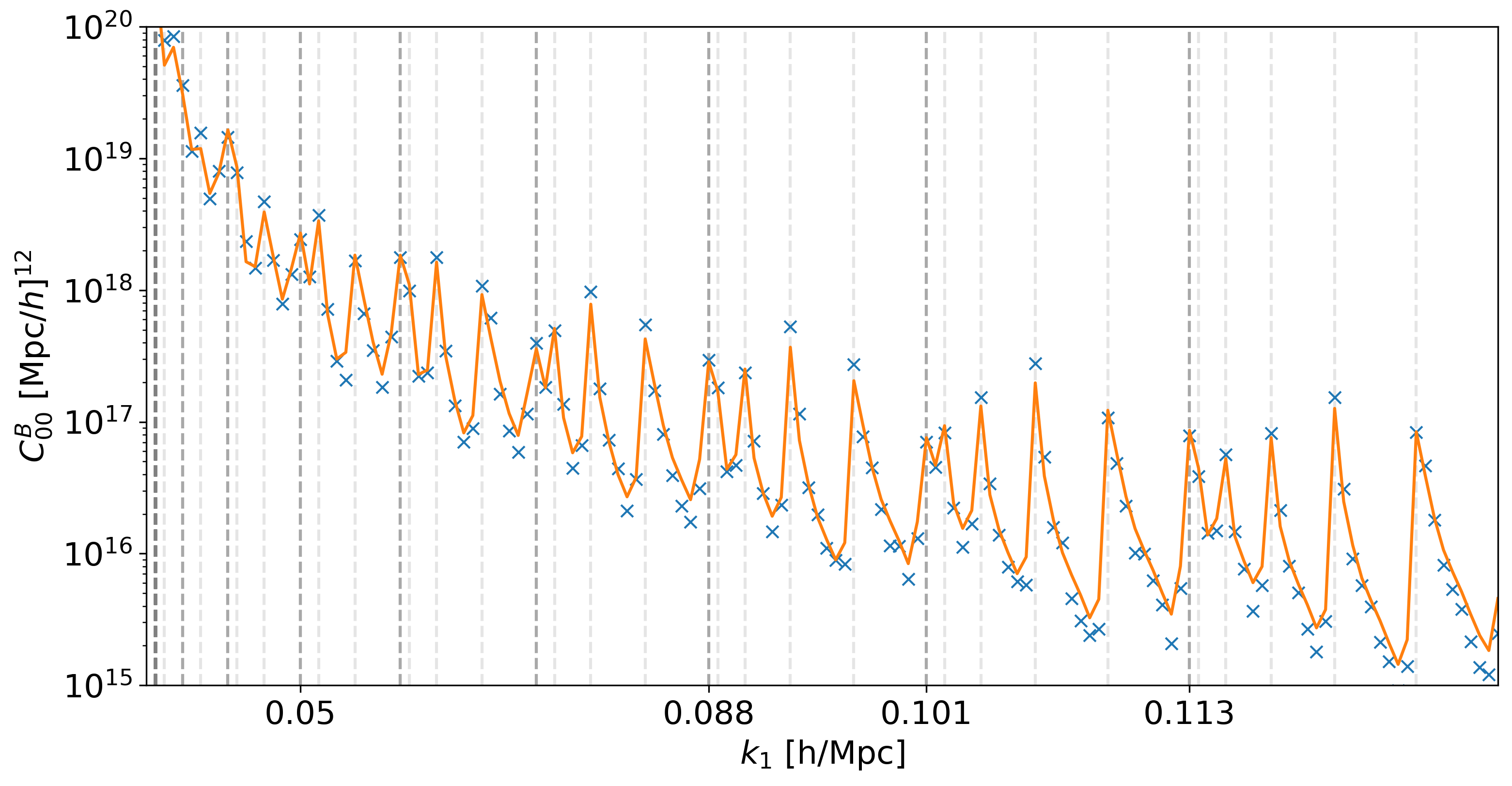
Comparison with Simulations
Gaussian covariance compared to the measured covariance from 100 fiducial Quijote simulations.
Analytical Expressions
Analytically-mu multipole covariance expressions (exported from Mathematica) are also available for the Newtonian tree-level case, optionally including FoG damping.
Power spectrum:
pk.COVprovides methodsN00(),N20(),N22(),N40(),N42(),N44()(even) andN11(),N31(),N33()(odd) for \(C[P_{\ell_1}, P_{\ell_2}](k)\).Power spectrum numerical:
pk.COV_MUprovidescov_l1l2(term1, term2, l1, l2, ...)for numerically integrating arbitrary term pairs.Bispectrum:
bk.COVprovides analytical multipole methods (e.g.N00(),N20(),N00_00()) with naming conventionNab_cdfor \(C[B_{\ell_1=a,m_1=b}, B_{\ell_2=c,m_2=d}]\). Whensigmais set,bk.COVautomatically switches to numerical \(\mu\)-\(\phi\) integration via itsylm()method.